Thursday, 3 June 2010
Image/Object Analysis Proposal

Blythe House Archive

Chirs Ofili at the Tate Britain
Ofili has built an international reputation with his works that bridge the sacred and the profane, popular culture and beliefs. His exuberant paintings are renowned for their rich layering and inventive use of media, including balls of elephant dung that punctuate the canvas and support them at their base, as well as glitter, resin, map pins and magazine cut-outs.
Ofili's early works draw on a wide range of influences, from Zimbabwean cave painting to blaxploitation movies, fusing comic book heroes and icons of funk and hip-hop. For the first time, these celebrated paintings are presented alongside current developments in his practice following his move to Trinidad in 2005. While adopting a simplified colour palette and pared-down forms, his recent works continue to draw on diverse sources of inspiration, and are full of references to sensual and Biblical themes as well as explore Trinidad’s landscape and mythology.
Definite highlights include No Woman, No Cry, 1998, a tender portrait of a weeping female figure created in the aftermath of the Stephen Lawrence inquiry and The Upper Room 1999–2002, a darkened, walnut-panelled room containing thirteen canvases depicting rhesus macaque monkeys. Each is differentiated in bold colours, and individually spot-lit.
Ofili is an artist that i have grown to adore and appreciate in many way, but the one that connects with me is the way he uses his background and roots and shows them in his paintings.
Sir John Soane’s Museum

Soane was born in 1753, the son of a bricklayer, and died after a long and distinguished career, in 1837.
Soane designed this house to live in, but also as a setting for his antiquities and his works of art. After the death of his wife (1815), he lived here alone, constantly adding to and rearranging his collections. Having been deeply disappointed by the conduct of his two sons, one of whom survived him, he determined to establish the house as a museum to which 'amateurs and students' should have access.
On his appointment as Professor of Architecture at the Royal Academy in 1806, Professor Soane began to arrange the Books, casts and models in order that the students might have the benefit of easy access to them and proposed opening his house for the use of the Royal Academy students the day before and the day after each of his lectures.
This laid the foundations for the museum which continues to attract many visitors year after year.
Unfortunately i haven't had the chance to go and visit this amazing museum but its defiantly something that i have put down in my books.
Ethical Fashion Forum

This was a day that i had no clue about, got into Chelsea and it was full of stalls with amazing strange products.

Sunday, 31 January 2010
Telling Tales
The Forest Glade is inspired by fantasy and nature evoking the spirit of fairytales. The Enchanted Castle exaggerates and parodies historical design styles often associated with displays of status. Heaven and Hell is concerned with themes of mortality and the afterlife.
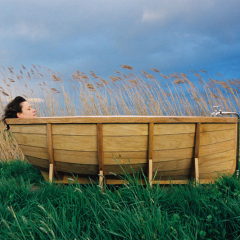
'Bathboat'
Wieki Somers
The 'Bathboat' is like a small boat turned inside out, designed to keep water in rather than keep it out. Wieki Somers wanted to make the connection between floating on the water and bathing in the water because they evoke many similar feelings and elements.

'Lathe Chair VIII'
Sebastian Brajkovic
The 'Lathe Chair' series was conceived by rotating 19th-century chair shapes around a central axis to stretch them. The finished chairs were cast in bronze, like sculpture, but remain functional as furniture. The upholstery was digitally designed. The result is a marriage of tradition and modernity.

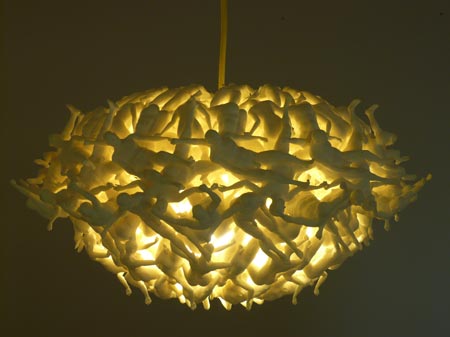
'Damned.MGX' chandelier
Luc Merx
The tumbling bodies that make up this chandelier were inspired by Peter Paul Rubens's depiction of the Fall of the Damned at the moment of God's last judgement. In western art the human body is often a metaphor for spiritual attributes. By using the body in a work of design, Merx seems implicitly to equate the value of design and art.
Rough Guide
Known for its music scene, its ethnic and social diversity, and its altercations with the police, the latter of which is immortalized in the Clash song “Guns of Brixton.”
There is a various mix of African, Caribbean, Indian, Vietnamese, Chinese and Middle Eastern poets, musicians, artists, activists, anarchists and bohemians.
Brixton used to be known as Brixistane and was mostly dull farmland until the Vauxhall Bridge opened in 1816. Better transportation options turned the area into a suburban paradise, with huge Victorian houses sprouting up along the main roads. These buildings were being converted into flats and boarding houses by the start of the 20th century, and the 1940s and ‘50s saw waves of immigrants from the Caribbean settling in the area. Tensions between the (mostly black) community and the (mostly white) police force grew, culminating in the notorious riots of 1981 and 1985.
Brixton Market
It's lively, vibrates to the sound of reggae, and it's busy.Brixton Market offers the largest collection of Afro-Caribbean food in Europe, an assortment from shark and goats' meat, pigs' tails and salt fish to plantain, okra, breadfruit and yams.
The main attraction in Brixton for me has to be the fish market, everywhere you look there is fish, amazing different types, colour shapes and sizes and every stall displays the product in such a beautiful way that every time i walk by i stop and admire the view, and to be honest with you i don't think i have ever bought a fresh fish in my life, i have always just been attracted by there textures and vibrant colours.