Thursday, 3 June 2010

Alternative Fashion Week 2010


This was such an amazing experience, never did i think that i would get the chance to do something like this.


Image/Object Analysis Proposal


Within this essay I am going to discus how traditional Romanian textiles have influenced my own work. I will look at Romanian folk art, fine art and contemporary Eastern European art practice. Through researching my own past I will explore why these elements are significant to the development of my ideas.

Famous historian of religion, Mircea Eliade# said that " Romanians artistic genius found infinite possibilities of expression in the minor arts. The embroideries made by the Romanians are among the best of this kind. The artistic treasure of the Romanians is a living thing. He turns into a work of art everything he touches ,actuated by a pure inner need ,by a requirement of his instinct. There are no such things as serial works for each object is unique. Creation is continuous; in other words, once created, a work is not separated from the source of inspiration, it never get "fixed", it is never perfect ."

As a child my grandmother taught me a lot of my skills such as knitting, weaving and making traditional Romanian ornaments around the house such as, scarves, rugs and cotton doilies. My current work explores memories from growing up in Romania. This involves research into past and present cultures and responses to the effects on my life since moving to England eight years ago

Blythe House Archive

Pages of a letter from William Morris dated 20 Dec 1886 recommending the purchase of a tapestry depicting the story of the Trojan War.


The institutional archives of the V&A and its predecessor organisations date from 1837 to the present day, providing a rich resource for the study of the history and influence of the Museum. The archives held include files relating to the acquisition of Museum objects; the organisation of V&A exhibitions; and the policies and development of the Museum. There are also inventories, ephemera and posters; photographs of the Museum, its objects and staff; volumes of press cuttings relating to the V&A and the art-world; architectural plans and models.

Blythe House was such an interesting experience, i never knew anything like this existed.
Going there opened up a whole new world for me, i could just spend hours and days looking through all the archives, it was amazing getting to see all the books ,designs and prints .All i wanted to to is just touch them. This is defiantly a place where i will come back and do hours of research and get inspiration from.


Chirs Ofili at the Tate Britain


Ofili has built an international reputation with his works that bridge the sacred and the profane, popular culture and beliefs. His exuberant paintings are renowned for their rich layering and inventive use of media, including balls of elephant dung that punctuate the canvas and support them at their base, as well as glitter, resin, map pins and magazine cut-outs.

Ofili's early works draw on a wide range of influences, from Zimbabwean cave painting to blaxploitation movies, fusing comic book heroes and icons of funk and hip-hop. For the first time, these celebrated paintings are presented alongside current developments in his practice following his move to Trinidad in 2005. While adopting a simplified colour palette and pared-down forms, his recent works continue to draw on diverse sources of inspiration, and are full of references to sensual and Biblical themes as well as explore Trinidad’s landscape and mythology.

Definite highlights include No Woman, No Cry, 1998, a tender portrait of a weeping female figure created in the aftermath of the Stephen Lawrence inquiry and The Upper Room 1999–2002, a darkened, walnut-panelled room containing thirteen canvases depicting rhesus macaque monkeys. Each is differentiated in bold colours, and individually spot-lit.

Ofili is an artist that i have grown to adore and appreciate in many way, but the one that connects with me is the way he uses his background and roots and shows them in his paintings.

Sir John Soane’s Museum


Soane was born in 1753, the son of a bricklayer, and died after a long and distinguished career, in 1837.

Soane designed this house to live in, but also as a setting for his antiquities and his works of art. After the death of his wife (1815), he lived here alone, constantly adding to and rearranging his collections. Having been deeply disappointed by the conduct of his two sons, one of whom survived him, he determined to establish the house as a museum to which 'amateurs and students' should have access.

On his appointment as Professor of Architecture at the Royal Academy in 1806, Professor Soane began to arrange the Books, casts and models in order that the students might have the benefit of easy access to them and proposed opening his house for the use of the Royal Academy students the day before and the day after each of his lectures.

This laid the foundations for the museum which continues to attract many visitors year after year.

Unfortunately i haven't had the chance to go and visit this amazing museum but its defiantly something that i have put down in my books.

Ethical Fashion Forum


This was a day that i had no clue about, got into Chelsea and it was full of stalls with amazing strange products.
The EFF is the industry body for ethical fashion. The forum brings together thousands of fashion businesses, organizations and individuals with a focus on social and environmental sustainability in the fashion industry.
The fashion industry remains one of the most exploitive in the world, both to people and environment. Poor working conditions, low wages and environmental damage are widespread.
At the same time, hundreds of fashion designers, entrepreneurs and established businesses are doing ground-breaking work, changing the lives of thousands of people behind their products and reducing environmental impact through sustainable practices.
A not for profit organization, the EFF works with the industry and costumers to reduce poverty, create sustainable livelihoods for garment workers, and reduce the impact of the industry on the environment.

As i was walking through all the different stalls i came across Beautiful Sole witch grabbed my attention.
Nicola believes in the power of fashion to influence trends in a positive way, and Beautiful Soul has grown organically from this premise. The label nurtures its workforce by providing training and motivation within less privileged communities around the UK and the World. With a strong ethical focus, the label ensures that its wearers can confidently embrace the policy of beauty from within.
As a lone player, change is difficult to influence, but individuals acting as a unified force can make change tangible. Nicola aims to share her knowledge and experience with emerging creative talents to garner collective recognition.
Beautiful Soul aims to recycle the most 'scrumptious ingredients' from around the world sympathetically, and has made a name for itself with its unique use of vintage Japanese kimonos. The label does not conform to 'throw away fashion' but instead combines luxurious vintage fabrics with sustainable alternatives. The materials and innovative design combine to give the wearer a truly unique fashion experience.

Nicole was one of the ladies that took her time to explain what her work was all about and gave me a lot of information about the industry and how i could be part. I love the materials she uses and everything she stands for.

Sunday, 31 January 2010

Telling Tales


This exhibition explores the recent trend among European designers for unique or limited edition pieces that push the boundaries between art and design. It showcases furniture, lighting and ceramics, designed by a new generation of international designers, including Tord Boontje, Maarten Baas, Jurgen Bey and Studio Job, who are all inspired by the spirit of story-telling. Each tells a tale through their use of decorative devices, historical allusions or choice of materials, sharing common themes such as fantasy, parody and a concern with mortality.


The exhibition is in three sections:
The Forest Glade is inspired by fantasy and nature evoking the spirit of fairytales. The Enchanted Castle exaggerates and parodies historical design styles often associated with displays of status. Heaven and Hell is concerned with themes of mortality and the afterlife.


When i first stepped foot in the exhibition I was overwhelmed, the place seemed so small but there was so much going on round me and it was packed with so many beautiful objects, i didn't know where to start and what to put my eye on first. If i was the only person in that place i think i would of been a bit scared, so in a way I'm glad there were little school children running about allover the place.


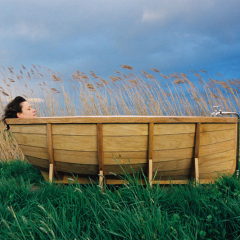
'Bathboat'

Wieki Somers


The 'Bathboat' is like a small boat turned inside out, designed to keep water in rather than keep it out. Wieki Somers wanted to make the connection between floating on the water and bathing in the water because they evoke many similar feelings and elements.

One of the reasons i absolutely love this pice, is purely because i would love to have bathboat in my house.

'Lathe Chair VIII'

Sebastian Brajkovic


The 'Lathe Chair' series was conceived by rotating 19th-century chair shapes around a central axis to stretch them. The finished chairs were cast in bronze, like sculpture, but remain functional as furniture. The upholstery was digitally designed. The result is a marriage of tradition and modernity.


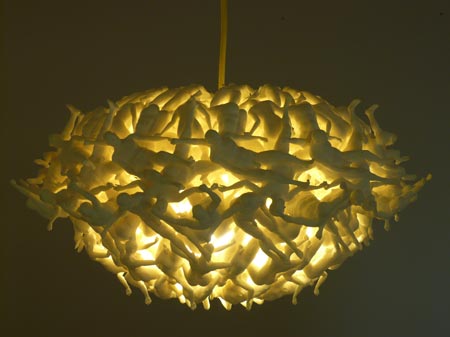
'Damned.MGX' chandelier

Luc Merx


The tumbling bodies that make up this chandelier were inspired by Peter Paul Rubens's depiction of the Fall of the Damned at the moment of God's last judgement. In western art the human body is often a metaphor for spiritual attributes. By using the body in a work of design, Merx seems implicitly to equate the value of design and art.